
Heart vs. Diamond Face Shape: How to Tell the Difference
Heart and diamond faces can both have prominent cheekbones and narrow chins. Learn the one defining difference, compare each feature, and check your result at home.
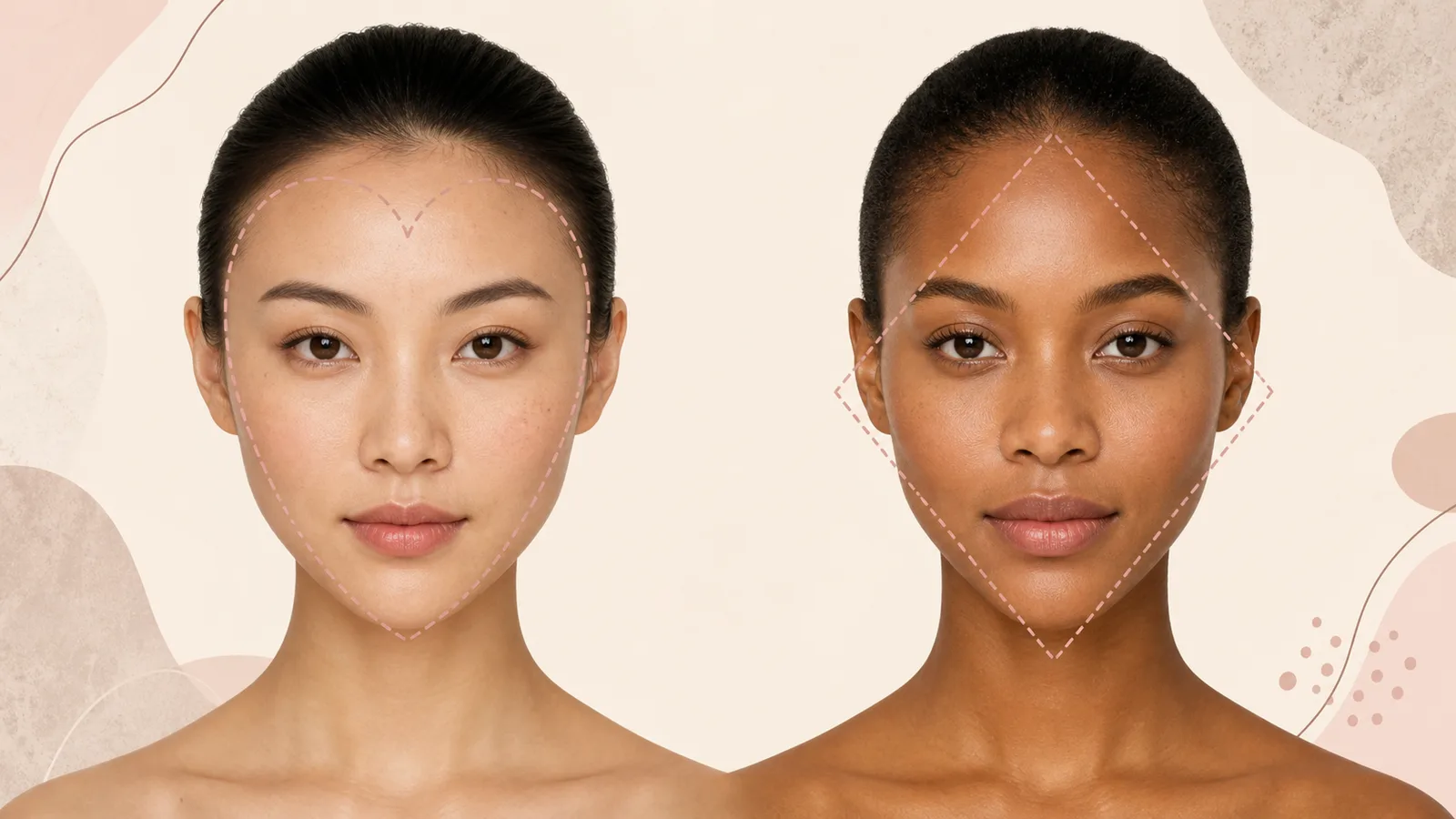
The quickest way to tell a heart vs. diamond face shape apart is to find the widest part of your face. A heart-shaped face is usually widest at the forehead and gradually narrows toward the chin. A diamond-shaped face is widest at the cheekbones, while both the forehead and jaw appear narrower.
That sounds simple, but these two shapes are easy to confuse. Both may have high cheekbones, a tapered lower face, and a narrow or pointed chin. Hair volume, camera angle, and even the way light falls across the temples can make one shape look like the other. This guide gives you a more reliable side-by-side method.
Heart vs. Diamond Face Shape: The Short Answer
| Feature | Heart face | Diamond face |
|---|---|---|
| Widest point | Forehead or upper face | Cheekbones |
| Forehead | Broad compared with the jaw | Narrower than the cheekbones |
| Cheekbones | Visible, but usually not wider than the forehead | Prominent and clearly the widest area |
| Jawline | Tapers steadily from the upper face | Narrows sharply below the cheekbones |
| Chin | Often narrow or pointed | Often narrow or pointed |
| Overall outline | Top-heavy, like an inverted triangle with softer curves | Widest through the middle, tapering above and below |
Use this one-question test: When your hair is pulled back, does your face look widest across your forehead or across your cheekbones? Forehead suggests heart; cheekbones suggest diamond.
What Does a Heart-Shaped Face Look Like?
A heart-shaped face carries more visual width in its upper third. The forehead may be broad, the cheekbones may be high, and the outline gradually tapers toward a smaller jaw and chin. A widow's peak can strengthen the heart impression, but it is not required. Your underlying proportions matter more than the shape of your hairline.
Look for these features together:
- The forehead is the widest area, or roughly tied with the cheekbones.
- The sides of the face narrow as they move toward the jaw.
- The jaw is noticeably slimmer than the upper face.
- The chin may look pointed, delicate, or softly tapered.
A broad forehead by itself does not automatically mean heart-shaped. If the jaw is also broad and angular, the face may lean square. If the forehead, cheekbones, and jaw are balanced with softly curved sides, it may lean oval instead.
What Does a Diamond-Shaped Face Look Like?
A diamond-shaped face carries its greatest width through the middle. The cheekbones extend farther than both the forehead and jaw, creating a distinct taper in both directions. The temples may appear narrower, and the lower face often angles inward toward a slim chin.
Look for this combination:
- The cheekbones are clearly the widest part of the face.
- The forehead is narrower than the cheekbones, especially around the temples.
- The jawline tapers inward below the cheekbones.
- The chin may be narrow, pointed, or slightly angular.
Prominent cheekbones alone do not make a face diamond-shaped. An oval face can also have noticeable cheekbones, but its transitions are usually gentler and its forehead-to-jaw balance is more even.
How to Measure a Heart or Diamond Face
You do not need perfect measurements. You are comparing proportions, so use the same method and unit for every measurement. A soft tape measure works well; a piece of string marked against a ruler also works.
- Pull your hair completely back. Make sure you can see both sides of your natural hairline and the full jaw.
- Measure the forehead. Measure across its widest visible point, usually between the hairline and eyebrows.
- Measure the cheekbones. Measure straight across the most prominent points beneath the outer corners of the eyes.
- Measure the jaw. Measure from one jaw angle to the tip of the chin and double it, or measure across both jaw angles in a straight-on photo.
- Compare the widths. The largest measurement is more useful here than the exact number.
If the forehead is widest and the widths generally decrease toward the chin, the face leans heart-shaped. If the cheekbones are widest and both the forehead and jaw are distinctly narrower, it leans diamond-shaped. For a broader overview of all seven categories, read our guide to understanding face shapes.
Why Photos Can Make the Two Shapes Look Similar
A close selfie can enlarge the center of the face and make the cheekbones appear more dominant. Turning the head slightly can reduce the apparent width on one side. Bangs can hide a broad forehead, while side lighting can exaggerate cheekbone shadows. These changes do not alter your structure, but they can alter the outline visible in a single image.
For a clearer comparison, use a straight-on photo taken from a little distance, with even light, a neutral expression, and hair away from the face. Our guide to AI face shape detector accuracy explains how each photo variable affects a result.
Can You Be Both Heart and Diamond?
Yes—at least in practical styling terms. Face shapes are descriptive categories, not rigid biological types. Someone can have cheekbones that are only slightly wider than the forehead, producing a heart-diamond blend. Weight changes, aging, hairstyle, and facial expression can also change which feature looks most prominent.
If your measurements are close, treat the result as a range. Try recommendations from both shapes and pay attention to the placement principle behind them: heart-face suggestions often balance a broader upper face, while diamond-face suggestions often soften or complement prominent cheekbones.
Style Starting Points for Each Shape
Hair for a heart-shaped face
Side-swept or curtain bangs can break up the visual width of the forehead. Chin-length bobs, waves beginning below the cheekbones, and styles with fullness near the jaw can create balance. These are starting points rather than restrictions—hair texture, density, and daily styling routine matter too.
Hair for a diamond-shaped face
Soft layers, side parts, curtain bangs, and chin-length or shoulder-length shapes can complement prominent cheekbones. Volume around the forehead or jaw can create a more even outline. Avoid treating the cheekbones as something that must be hidden; they are often the feature people most want to emphasize.
Glasses for heart and diamond faces
Heart faces often work well with frames that feel lighter across the top or carry subtle width lower in the frame. Diamond faces can experiment with oval, browline, or gently upswept frames that relate to the cheekbones without sitting too wide. Proper bridge fit, frame width, and comfort matter more than any face-shape rule.
Makeup placement
For a heart-shaped face, blush placed slightly outward and lower can draw attention toward the center and lower face. For a diamond-shaped face, a softer blush placement that does not extend beyond the cheekbone's widest point can keep the look balanced. Use makeup to explore emphasis, not to “correct” your natural structure.
Frequently Asked Questions
What is the main difference between a heart and diamond face?
The widest point is the main difference. A heart face is widest at the forehead or upper face. A diamond face is widest at the cheekbones, with a narrower forehead and jaw.
Does a widow's peak mean I have a heart-shaped face?
No. A widow's peak can make the outline resemble a heart, but face shape depends on the relative widths of the forehead, cheekbones, and jaw, plus overall face length.
Can a diamond face have a wide forehead?
A true diamond pattern normally has cheekbones wider than the forehead. If the forehead is equally wide or wider, the face may lean heart-shaped, oval, or a blend.
Are heart and inverted-triangle faces the same?
The terms are often used interchangeably. Some systems use “heart” for a softer or more curved outline and “inverted triangle” for a straighter, more angular one.
What should I do if my measurements are almost equal?
Retake each measurement, use a straight-on photo, and consider both categories. Small differences are normal, and styling recommendations can be mixed rather than treated as rules.
Check Your Face Shape
If you are still deciding between heart and diamond, use the free AI face shape detector with a clear, straight-on photo. Compare its explanation with your own forehead and cheekbone measurements instead of relying on the label alone.
Filed under
face-shapes
Editor, My Face Shape Detector
Brooke Tanner writes and edits the face shape guides on My Face Shape Detector, and checks the detector's classifications against the same measurement rules those guides describe.
Related face shape guides


Free AI Tool
Discover your face shape instantly
Upload a photo and get personalized style recommendations in seconds.
Back to Blog
7 min read